|
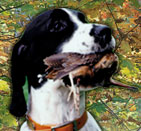
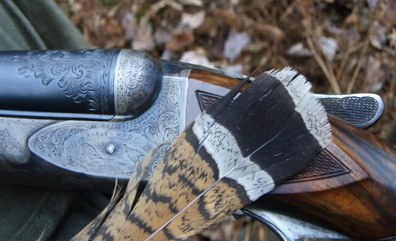
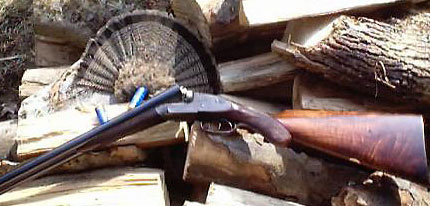
The makings of a fine day afield. Photo by Dave Popa |
|
|
GAME SHOOTING BETTER
Some observations and perspective
I’ve had a really interesting opportunity to observe and help many, many shooters of all different levels. I believe I have walked away with some insight that merits sharing with some of you. I’m hoping this will help some of you to understand that shooting well can be learned and obtained by anyone willing to get some help. These observations will, in all probability enhance your game shooting abilities as well as your target crushing abilities.
Mounting and gun management: With few exceptions, almost everyone that has come to me lacked a technical mount. They all had a “movement” whereby they were bringing the gun to the shoulder, but it was not a mount in the true technical sense of the concept. Proper gun holding and consistency in grip efficiency and parallel gun management was also non-existent. Every single person that made a decision to try a better hold and mount unanimously discovered the beginning feelings of true gun control.
PC’s tip: You MUST learn to mount properly and manage the man/machine interface correctly if you want your shooting to advance. Only when your mount advances to a smooth, consistent and subtle control will you be able to start using your eyes. You shoot with your eyes. As soon as you accept this simple fact, you will be ready to advance.
Reasons for missing: I’ve noticed that there are three distinct reasons people miss 95% of the time. I’ve purposely left out the “lead” and the “behind” concepts as they really are not meaningful in this context. I’ve also noticed that almost everyone is capable of shooting relatively well but they needlessly handicap their abilities in three separate but distinct areas.
1. Effective eye utilization
2. Improper balance/centering
3. Grossly unmanaged gun movements
Using your eyes: You shoot with your eyes. Learn to use them for the incredibly effective tool that they are. If you use them correctly, targets and game actually look slower and larger for a brief period of time. It becomes easier to hit “bigger and slower” objects. Learn how to see detail crisply. I don’t care if it is a crest on a bird, his eye, a tail band, curled feet, shiny edges on a target, an underside of a target or even a wobble in the target flight. SEE SOMETHING other that a mass of blurred feathers or an orange dome in flight. Seeing the leading or forward edge of any object is a very good initial goal. Seeing the leading area of any object for as long as possible is a solid start.
PC’s tip: Understand human eyesight. It can be your biggest shooting asset BUT it can cripple your shooting too. Our eyes will always move directly to the object moving fastest in our field of view. We are biologically wired this way. If you move your gun significantly faster than a target or a bird, your eyes will move to the barrel. This is bad. You must maintain crisp object focus to consistently hit flying objects. You cannot maintain crisp object focus if your eyes move to your gun because you mismanage gun movement or lack target flight/gun speed harmony. Good eye skills must be taught and learned. Get instruction on eye use. The best game and target shots all have superior eye skills. Not necessarily better visual acuity, but certainly better eye skills.
Balance/centering and footwork: All physical endeavors rely on balance and form. Boxing is a classic example. “Punch” in boxing comes from your rear leg/foot, not your arm. Shooting is no different.
The human frame has limitations in effective, useful movement. Most people have a 90-degree arc on their offhand side that I call their “Sweet spot”. If you try to shoot outside of this range of motion you will be substantially handicapped by restricted physical motion. Good shooting requires a harmonious flow of body, gun and eyes. If your mount is solid and your eye work correct, this range of motion will become larger and more useful.
The discreet target forms like Skeet and Sporting usually dictate presentation and the shooter position. Game birds do NOT give us that luxury. They can flush from any angle and compromise our effective shooting arc and balance points. Good game shooting requires active, passive and dynamic balance changes. As your mount and eye work increase in effectiveness, so too will your arc of effectiveness. This smoothness in skill is why some of us can shoot clays with one hand or behind our backs. We simply are more effective in a wider range of motion.
PC’s tip: Learn solid, but dynamic, form. Your feet, hands and eyes are what kill birds and break targets. Balance skills and pivot shooting are essential upland footwork. Melding smooth, balanced body movements with smooth, balanced mounts/ gun management and effective use of your eyes will simplify your shooting. These are skills that can be taught, learned and honed.
Managing gun movement: I see many folks come to me with sweeping gun movements and uncontrolled gun motions. Unnecessary gun movement equals shooter error. Smooth, controlled and perhaps more importantly, balanced gun movement, will make precision pointing far more easier and almost a subconscious activity.
Typical field carries are ripe for sweeping gun movements. Having a “home mount” to move through will significantly reduce wasted and error prone movement. Ever wonder why “straight aways” can be such an easy shot to miss? Gross gun movement with lots of error prone, wasted movement. Want to become absolutely deadly with a low gun on a quartering, rising, going away target? I can show you how to crush these birds low gun like you’ve done it a thousand times.
It’s all about economy of effective movement. Watch a really good shooter sometime and you will start to see minimal gun movements with maximum effectiveness, even on fast crossers.
PC’s tip: Gun management has its origins in mount. Good mounting always requires “Eyes First” as a prerequisite to any movement. Seeing target/birds and making your initial movements without getting beat by the object requires an efficient use of your eyes, hands and balance. Starting to see a pattern here? You shoot with your eyes, hands and feet. Not a gun. The gun is simply a tool, no different than say a hammer or a golf club. When you hammer a nail, do you look at the hammer? Do you ever see a club face when you swing? Learning how/when to move your hands/gun and how/when not to move them are very teachable and easy to learn. Your precision as a shotgun pointer will dramatically improve when you can control small, smooth movements. Your margin for error will also dramatically be reduced. Instruction is the best way to learn effective gun management.
If you were inclined to just focus on just these four concepts, your shooting MUST improve. It would be an inescapable reality. Good luck to those of you that take that next step.
In the end, we all love to hunt, watch the dogs work and shoot a few birds. If these concepts help any of you to understand your gunning self better, then my work has some meaning.
By Dave Popa
a.k.a., PartridgeCartridge (PC) on the Upland Talk Bulletin Board
While not acting as the resident upland raconteur and provocateur on the Upland Journal Bulletin Board, PC is a skilled upland and clay shotgun shooter, instructor and overall sportsman.
|